
Print shop management
Written for a print shop, not adapted to one.
Email, customers, quotes, jobs and files in one place that knows what a sheet, a plate and a finishing pass are. Most shops end up on a generic CRM or on software built for garment printing. Both work. Neither knows your trade.
Start a 30-day trialNo card. Nothing to install.
What "knows your trade" actually means
Email is where it starts, not a separate app
Your Gmail lives inside the platform. The customer's messages sit beside the customer's quote — you are not searching two places to find out who said what.
The request turns itself into a quote
The AI reads the email and fills in size, quantity and stock — separating what the customer said, what their history shows, and what is still missing.
The price comes out of your machines
It is not a field you type into. It is the cost of your presses, your paper and your finishing, plus the margin you set.
An approval becomes a job
The customer approves and the job exists. Nothing is re-keyed, nothing is copied across, nothing is forgotten in an inbox.
The files know where they belong
The job folder creates itself, with the quote number and the customer in its name. PressKit on the desktop knows which job you are on.
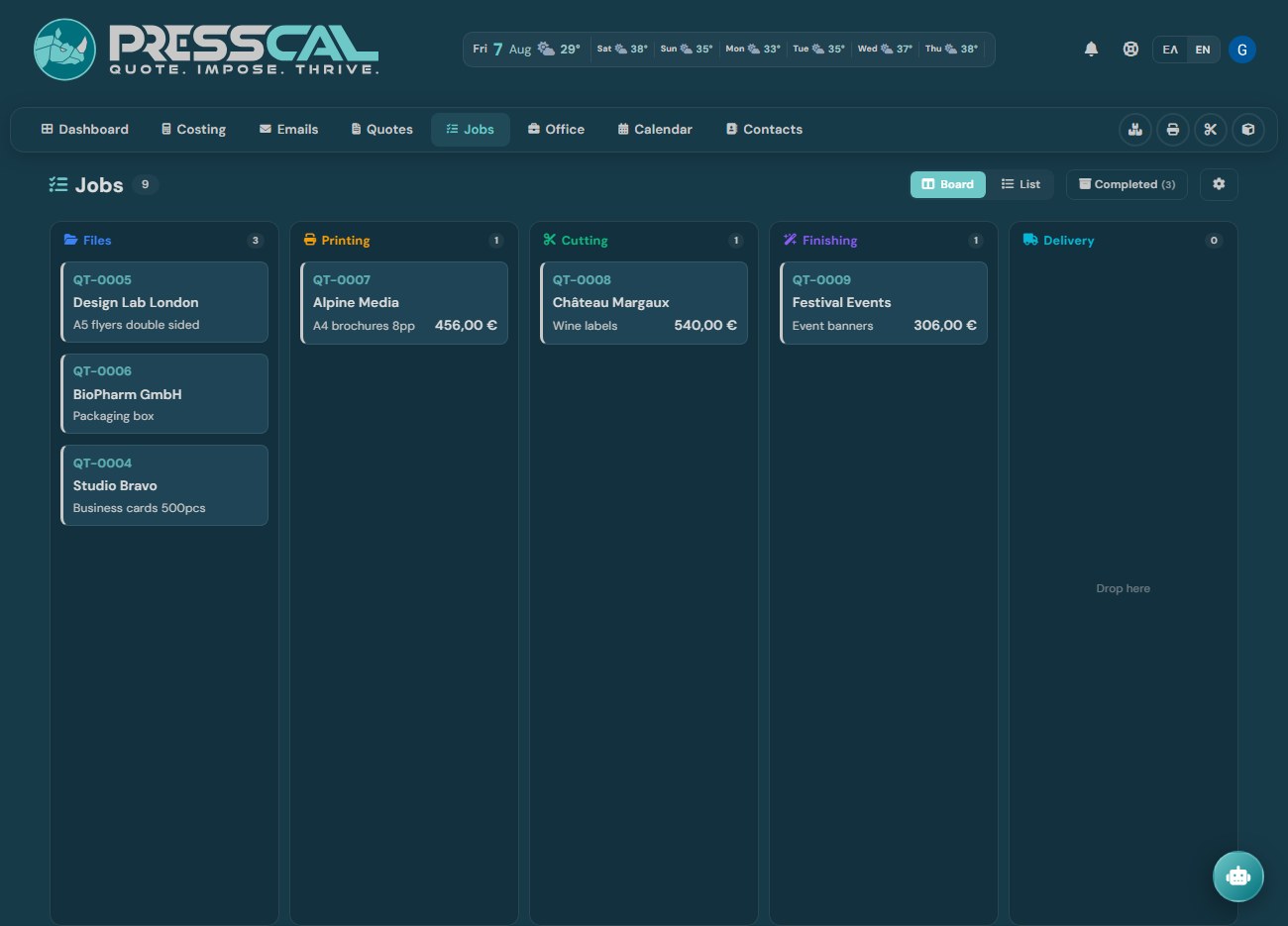
The board speaks the language of the shop
Files, Printing, Cutting, Finishing, Delivery — renamed to whatever you call them. Inside each card, the production docket: press, sides, plates, ups and the cutting guide.
Why a general tool is not enough
- A CRM knows contacts and deals. It does not know that the same job on a different sheet costs a different amount.
- A project tool knows cards and due dates. It does not know that the sheets come out of the imposition, and that the imposition sets the price.
- The software in this category is built for screen printing, signage and promotional goods. Good for them; no plate and no sheet for you.
- The spreadsheet knows your job exactly — and nothing else. It does not send the quote, keep the history, or show your colleague where things stand.
- The result is always the same: three or four programs, and you keeping them in step by hand.
And because it is all one thing, the costing and the imposition are already inside
Not an add-on, not a second subscription. The imposition decides how many sheets, the sheets decide the price, the price becomes a quote and the quote becomes a job — on one screen, with nothing retyped in between. That is the part a stack of three good tools cannot give you, however good each one is.
See how it comparesFrequently asked questions
I already have Gmail and Excel. What do I gain?
Gmail stays — you just see it inside the platform, with the customer's emails beside the customer's quote. Excel is the part that goes: costing stops being a file you copy and becomes something that knows your machines and produces the quote itself.
Is this for large printers?
No. It is built for shops of two to ten people. Industrial MIS products need installation, training, and usually do not publish a price at all — that is a different class of product for a different size of business.
How long does setup take?
Setup is your machines, your papers and your costs, and there is a step-by-step guide that walks you through all of it. The more accurately you enter them, the more correct every price it produces afterwards.
What about invoicing?
It connects to Elorus and the invoice goes out from the quote itself. Contacts push from PressCal to Elorus; products sync in both directions.
Does it work if I am on my own?
Yes, and that is where it shows most — when you are on your own, the time spent moving data between programs is your own time.